

Why Overthinking is Ruining Your Email Marketing
Do you have blank page syndrome?
You sit down to write "a quick email" but that damn cursor is blinking away at you, mocking you.
And somehow, a simple message has turned into your own personal episode of:
"Email Writing: Extreme Edition."
But be assured.
You're not alone... And it's not your fault.
The Surprising Reason You Can't Write Emails
Remember high school English class?
That moment when your teacher would say, "Write a five-paragraph essay about..."
*Cue instant stomach drop*
Here's the thing about that English class anxiety.
It never really went away. It just morphed into something new.
But now instead of worrying about essay grades, you're overthinking every single email you write.
And I mean every. single. one.
That "quick update" to your list? Three hours of rewrites.
That "simple announcement" about your new offering? FIVE different versions sitting in your drafts.
That "easy thank you" to your new subscriber? Somehow turned into an existential crisis about whether "Thanks!" feels too casual or "Thank you kindly" sounds too much like a Victorian novel.
(If you've ever Googled "how many exclamation points is too many exclamation points," I see you. I am you. 😅)
Ready to break free from this overthinking trap?
Your Brain Is Sabotaging You
The "rules" you learned in school? They're actually making your emails worse.
Does this sound familiar?
Your logical brain says: "Just sit down and write a quick message to your list."
Your anxiety brain says: "BUT WHAT IF IT'S NOT PERFECT?"
And suddenly, you're trapped in a mental wrestling match that has nothing to do with email marketing and everything to do with fear.
The fear of:
Looking unprofessional
Making mistakes
Being judged
Not sounding smart enough
Disappointing people
Being "found out" to be a fraud
This isn't a writing problem. It's a confidence problem disguised as a writing problem.
The Permission Slip You Never Got
Here's something your English teacher never gave you.
Permission.
Permission to break the rules, and permission to be imperfect.
Your readers aren't looking for perfect grammar, flawless transitions, or sophisticated vocabulary.
They're looking for help.
For connection.
For someone who understands their problems.
That's the human side of email marketing.
And it's way more powerful than perfection.
Think about it:
When's the last time you deleted an email because it had a comma splice
When's the last time you unsubscribed because someone used "gonna" instead of "going to"?
When's the last time you thought, "Wow, this email would be so much better if it followed MLA format"?
Never.
Because you're not grading papers. You're looking for value.
Your readers are doing the same thing.
(Well most, at least. Because yes there are grammar sticklers out there who will point out your every mistake but you know what they say about pleasing all the people all the time, right?)
So consider this your official permission slip to:
Write like you speak
Use simple words
Make mistakes
Sound human instead of corporate
Focus on helping instead of impressing
The Overthinking Death Spiral (And How to Escape It)
Let's go inside the mind of an email overthinker:
Step 1: The Innocent Beginning
You sit down to write a "quick email." Should take 15 minutes, tops.
Step 2: The Doubt Creeps In
"Wait, does this opening sound professional enough?"
Step 3: The Comparison Trap
"Everyone else's emails sound so much smarter than mine."
Step 4: The Perfectionism Paralysis
"Let me just rewrite this one sentence... seventeen more times."
Step 5: The Panic Mode
"I've been working on this for three hours and it's worse than when I started."
Step 6: The Defeat
Either you give up entirely, or you send something that sounds nothing like you.
Recognize this pattern?
Your Anti-Overthinking Toolkit
Here’s how to break it.
The 10-Minute Email Method
Set a timer for 10 minutes. Write your entire email in that time. No editing. No second-guessing. Just write.
When the timer goes off, you're done.
Do a quick once over and then send it.
"But what if it's not perfect?"
It won't be. That's the point.
Perfect emails don't exist. Helpful emails do.
The "Good Enough" Standard
Before you spend hours tweaking, ask yourself:
Does this help my reader?
Is my main point clear?
Would I want to receive this email?
Did you ask for what you want? (CTA)
If yes, hit send. Everything else is just procrastination dressed up as "quality control."
The 3-Minute Brain Dump
Set a timer for 3 minutes.
Write everything you want to say without stopping.
Don't worry about order, grammar, or making sense. Just get it out of your head and onto the screen.
This bypasses your inner critic because there's no time to judge what you're writing.
The One-Point Rule
Most emails should make exactly one point.
Not three points. Not five tips. One thing.
This makes writing easier because you're not trying to cover everything.
And your readers usually won't stick around when it's too much.
Think about your inbox? 100s of emails a day and someone's trying to give you life's entire handbook in an email?
Uhhhh, no thanks.
Just focus on one thing.
The Friend Test
Before you send, ask yourself: "Would I say this to a friend?"
If the answer is no, rewrite it until the answer is yes.
The Story-First Approach
When you're staring at a blank screen, don't start with your main point.
Start with something that just happened:
The weird conversation you overheard at the coffee shop
That thing your kid said that made you think
The mistake you made that taught you something
The random observation that connects to your point
This gives you a natural starting point instead of trying to craft the "perfect" opening. Because stories make your emails binge-worthy.
Want a complete system that makes this even easier?
Check out our post with a 30-day plan to help you create better emails faster with short daily exercises that eliminate the blank-screen problem.
Common Overthinking Traps
Trap #1: The "Professional Voice" Prison
What it sounds like: "We are pleased to inform you of our latest offering..."
Why it happens: You think "professional" means "formal and boring."
The escape route: Rethink professional. Make it mean helpful and reliable. Not robotic.
Try this instead: Write like you're explaining something to a friend over coffee.
Trap #2: The Vocabulary Upgrade Spiral
What it sounds like: Replacing "help" with "facilitate" and "use" with "utilize."
Why it happens: You think bigger words make you sound smarter.
The escape route: Simple words are powerful words. Your reader's time is valuable. Don't make them work harder to understand you.
Try this instead: Use the first word that comes to mind. It's usually the right one.
Trap #3: The Endless Edit Loop
What it looks like: Rewriting the same paragraph for 45 minutes.
Why it happens: You're trying to make it "perfect" instead of "done."
The escape route: Set editing limits. Three passes maximum. Then send.
Try this instead: Write it. Read it out loud once. Fix obvious errors. Send.
Trap #4: The Blank Screen Stare
What it looks like: Sitting there for 20 minutes without typing a word.
Why it happens: You're trying to think of the "perfect" opening.
The escape route: Start with anything. You can always change it later.
Try this instead: Begin with "So..." or "Here's what happened..." or "Quick question for you..."
The best way to start writing? Just start writing!
You can always go back and change it.
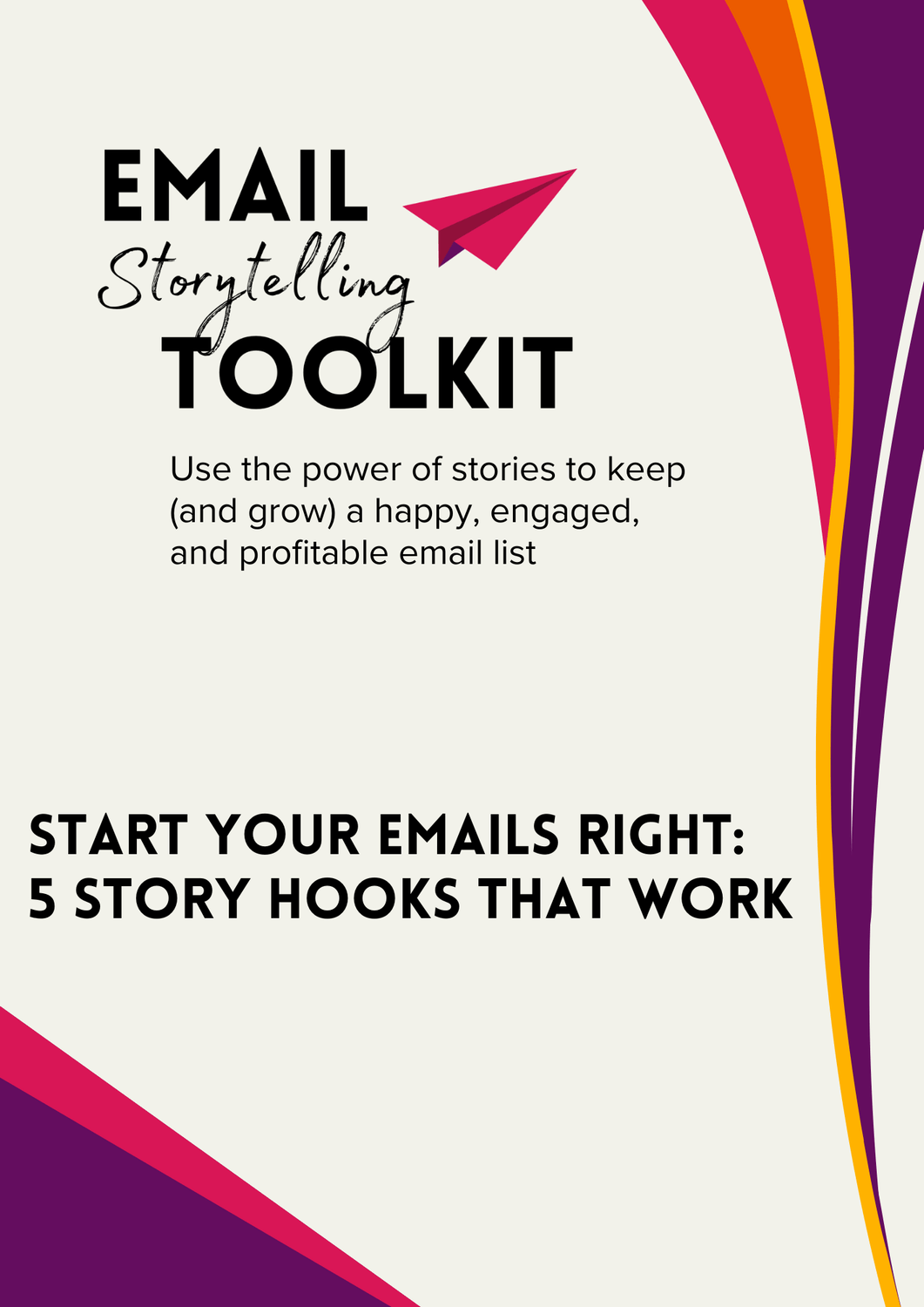
Get help starting your emails off right
Grab your free guide:
Start Your Emails Right: 5 Story Hooks That Work.
Get 5 proven opening hooks (with examples) to make your emails impossible to ignore.
The Real Cost of Overthinking
Here's what overthinking is actually costing you:
Time: Those three-hour email sessions could be spent on other revenue-generating activities.
Consistency: When writing emails feels hard, you do it less often. Inconsistent communication kills relationships. (A subscriber who doesn't remember you? Usually means and immediate unsubscribe.)
Authenticity: Over-edited emails lose your personality. Your readers connect with you, not your perfectly polished corporate voice.
Confidence: Every overthinking session reinforces the belief that you're "not good at this."
Results: Emails that took forever to write often perform worse than ones you wrote quickly.
And when you're not sending emails consistently, you're missing out on one of the most powerful (and profitable) marketing channels available.
The Simple Truth About Email Writing
Here's what successful email writers know that overthinkers don't.
Done is better than perfect. A helpful email sent today beats a perfect email never sent.
Your readers are busy. They want clear, useful information. They don't have time to decode your perfectly crafted prose.
Mistakes are human. A typo makes you relatable. A perfectly polished email makes you seem distant.
Consistency beats perfection. Regular, helpful emails build relationships. Sporadic, perfect emails don't.
Your voice is your advantage. Anyone can hire a copywriter. Only you can sound like you.
Your 7-Day Breakthrough Challenge
First your "Permission Statements"
Print them out. Stick them on your wall. Tattoo them on your forehead (OK not that but you get the point).
Done is better than perfect
My readers want real, not polished
Typos make me human
Nobody has ever died from an imperfect email
And then for the next seven days try this:
Day 1: Write one email in 10 minutes. Send it without editing.
Day 2: Write an email like you're texting a friend. Send it.
Day 3: Start an email in the middle of a thought or situation, then explain the context as you go.
Day 4: Write about one simple thing that happened to you. Send it.
Day 5: Answer one question your readers always ask. Send it.
Day 6: Share one mistake you made and what you learned. Send it.
Day 7: Write about why you do what you do. Send it.
Notice what happens. Most of your readers won't unsubscribe because of imperfection. They'll engage more because of authenticity.
When You're Ready to Make This Even Easier
Look, breaking the overthinking habit takes practice.
But what if you could skip some of the trial and error?
What if you had proven templates that eliminate the blank screen problem?
Frameworks that make writing faster?
A system that takes the guesswork out of what to say?
That's exactly what the Email Storytelling Toolkit provides:
60 fill-in-the-blank templates that eliminate writer's block
Simple frameworks for turning everyday moments into engaging emails
A step-by-step system for writing emails in minutes, not hours
Everything you need to write consistently without overthinking
→ Get the Email Storytelling Toolkit here
You're not trying to be the world's best copywriter (unless you are and in that case, there are TONS of copywriting courses you could be taking).
But for the rest of us, the goal is to become a consistent communicator as efficient as possible who helps people AND grows a business.
THE BOTTOM LINE
Stop dreading something that should be fun:
Connecting with your readers. (And making sales!)
Want to know one of the biggest secret about email writing?
The emails you think are "just okay" are often the ones your readers love most.
The stories you almost didn't share become someone else's breakthrough moment.
The imperfect emails that took 15 minutes to write often outperform the ones that took hours.
Keep these in mind next time you're staring down a blank screen:
Your emails don't need to be perfect. They need to be sent.
Your readers don't need Shakespeare. They need help.
Your business doesn't need award-winning copy. It needs consistent communication.
The world needs what you have to offer.
But they can't benefit from emails you never send.
P.S. Still overthinking whether your emails are "good enough"? Remember: The email that helps one person is infinitely more valuable than the perfect email that never gets written.
Created with ©systeme.io



Email Storytelling Toolkit | All Right Reserved 2025