

Why Email Marketing Still Rules (And Why Storytelling is Your Key to Making it Work)
Ever notice how your inbox is basically your digital living room?
It’s where newsletters you actually want to read hang out, where receipts and confirmations pile up, and yes, where brands try to get your attention.
Sometimes successfully, sometimes... not so much.
Here’s what most people miss about email marketing: it’s not just another marketing channel.
It’s the only channel where you own your audience.
No algorithm changes, no platform shutdowns, no “sorry, we’re changing our rules” surprises.
But first, let’s address the elephant in the room.
But Isn’t Email Marketing Dead?
If you’ve been listening to social media gurus, you might think email went the way of the fax machine. (Remember those? 😅)
“Everyone’s on TikTok now!”
“Nobody reads emails anymore!”
“It’s all about Instagram Reels!”
Here’s what they’re not telling you.
While everyone’s chasing the latest social media trend, email marketing is (still) quietly making people rich.
Like, really rich.
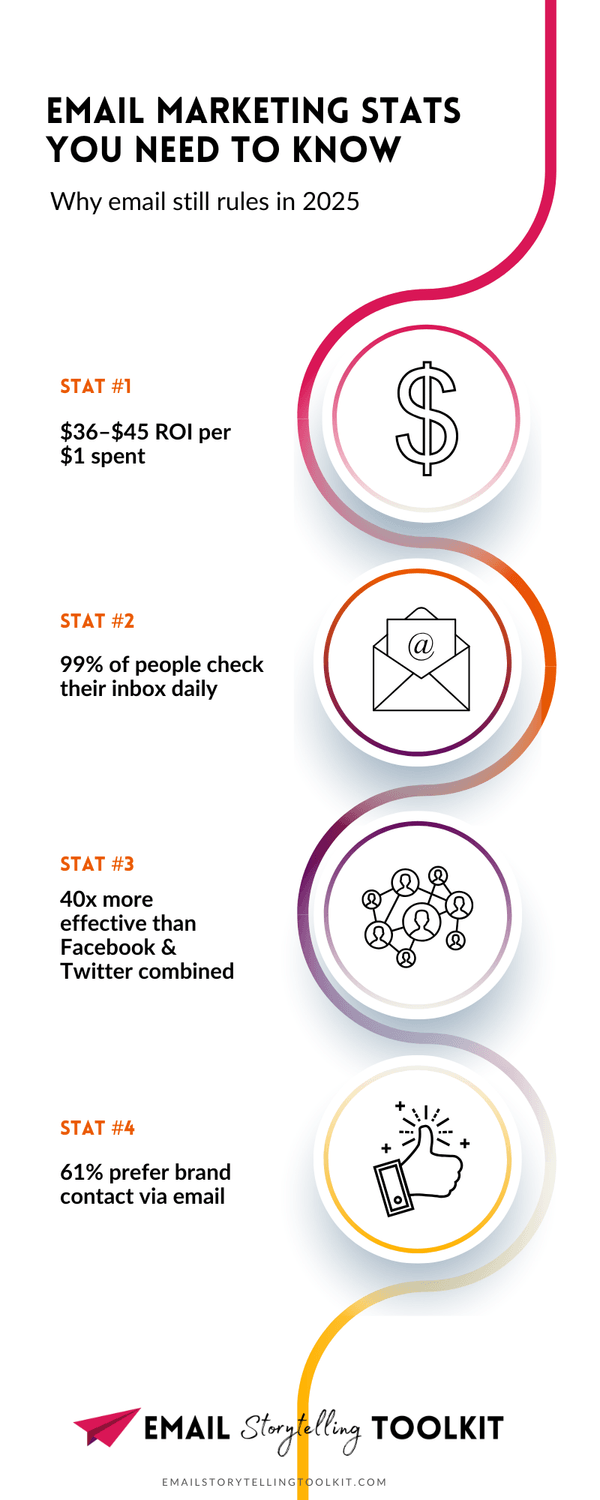
Consider these stats:
Email marketing delivers an average ROI of $36–$45 for every $1 spent. (Litmus)
99% of email users check their inbox daily, with 58% checking it first thing in the morning. (OptinMonster)
Email is 40x more effective at acquiring customers than Facebook or Twitter combined. (McKinsey & Company)
61% of consumers prefer to be contacted by brands via email. (Statista via AWeber)
The Real Problem Isn’t Email… It’s Boring Email
People don’t think email marketing is dead because the channel doesn’t work. They think it’s dead because most emails are mind-numbingly boring.
Does this look familiar:
“FLASH SALE! 50% OFF EVERYTHING!”
“5 Tips to Boost Your Productivity”
“Our Latest Product Update”
“Don’t Miss This Limited Time Offer!”
BIG yawn!
Delete. Delete. Delete.
Maybe even mark as spam for good measure.
So what about this instead:
“What happened when I spilled my latte on my celebrity crush...”
“I hate to admit it but... HE was right”
“My kid said the weirdest thing and it changed EVERYTHING”
“I was literally hiding under my desk when I figured this out…”
Tell me you’re not at least a little curious about what happens next.
That’s the difference between emails that get ignored and emails that get results. It’s not about the channel, it’s about the message.
Why Social Media Will Break Your Heart (But Email Won’t)
Social media is like yelling into a megaphone at the Super Bowl when the losing team just scored a touchdown.
But email?
It’s like having a coffee date with someone who actually wanted to meet you.
Here’s what happens when you build your business solely on social media:
Algorithm changes tank your reach overnight (this is true for search as well)
Platforms change their rules (and suddenly your content violates something)
Your account gets hacked, suspended, or deleted
You spend hours creating content that only 3% of your followers see
You’re constantly chasing trends just to stay visible
Meanwhile, your email list sits there completely under your control.
No algorithms deciding who sees your content.
No platform changes destroying your reach.
No wondering if your message actually made it to your audience.
But Here’s Where Most People Mess It Up
Most emails are terrible.
They sound like they were written by a robot trying to pass a business writing class.
“We are pleased to announce our latest offering…”
“In accordance with industry best practices…”
“We hope this email finds you well…”
Stop. Like for real. Just stop.
Nobody talks like this in real life.
So why do we write like this in emails?
Because we were taught that “professional” means boring. That business communication has to sound like a corporate policy manual.
Or people get caught up in their heads because they aren't a "writer" and forget the most important part...
You are a human talking to another human.
This is how you get people to look forward to your emails AND actually read them.
And then they remember you, tell their friends or colleagues about you, and even start to trust you enough to buy from you.
The Secret Sauce: Email Storytelling!
Remember the last time you binge-watched a TV series or couldn’t put down a book?
Why?
It's no secret. It's storytelling.
And your business emails can tap into that same power (and you don't have to be a Hollywood screenwriter or a bestselling novelist to do it).
Stories do three things bullet points can’t.
They make people feel something (and people buy based on emotion).
They help people remember your message (facts tell, stories sell).
They build trust (because they show you’re human, not just a brand).
Think about the last time you bought something significant.
There was probably a story involved. Either one you told yourself about why you needed it, or one you were told that made you believe in them.
Want to master this? Learn how to write binge-worthy emails using storytelling that keeps people hooked.
What Happens When You Don’t Tell Stories
Let’s be brutally honest about what boring emails cost you:
1. Your open rates tank.
When people see your name in their inbox and think “ugh, boring,” and it goes straight to the trash.
2. People forget you exist.
Without stories, your emails blend into the sea of corporate noise.
3. You lose sales.
Features and benefits don’t create urgency. Stories and emotions do.
(And not only are you not making any money, but zombie subscribers cost you money since ESPs charge based on number of contacts.)
4. Your best customers unsubscribe.
They never get to know the real you because your emails sound like everyone else’s.
5. You burn out.
Writing boring emails is exhausting. Trying to sound “professional” instead of human turns every email into a chore.
And when you add overthinking every word and sentence, email marketing becomes something you dread. Something you put off until never.
Not to mention writing email after email and never seeing the results you hoped for and instead watching your unsubscribes climb higher...
That makes anyone want to give up.
The Anatomy of Emails People Actually Want to Read
So what makes an email irresistible?
They start with a hook.
Not “I hope this finds you well,” but something intriguing, surprising, or story-based.
They sound like a conversation.
The best emails feel like they’re written by a friend, not a marketing department.
They tell stories.
Stories with a point. Stories that teach, connect, or inspire. And they don't have to be long. Sometimes it can just be a couple sentences.
They have a clear purpose.
Every great email teaches, shares, or asks for something.
They respect your time.
They’re as long as they need to be and no longer.
Want 5 story hooks you can use right now?
Get the free guide:
Start Your Emails Right: 5 Story Hooks That Work
You get:
✅ 5 proven hook types
✅ Why each one works
✅ Real examples you can swipe or adapt
No more blank-screen panic.
Just hooks that grab attention and make people want to know what happens next.
Get your free guide here today!
Three Types of Stories That Always Work
The Transformation Story
Someone — you, a client, a friend — was struggling, tried something (something you offer), and got results.
These work because they show what’s possible.
The Mistake Story
You tried something, it didn’t work, and you learned a lesson.
These build trust because you’re not pretending to be perfect.
And your audience can relate because more than likely, they've also made a mistake.
The Behind-the-Scenes Story
What really happens in your business or day.
These satisfy curiosity and make you human and gives them a possible glimpse into their own future (with your solution).
Pro tip:
The story isn’t the point. The lesson is.
How to Find Stories When You Think You Don’t Have Any
Maybe this sounds familiar.
You're ready. Sit down to start writing and nothing.
All your stories. All your ideas. Gone.
Your mind? Blank. Just an empty field with nothing but tumbleweeds rolling through.
And then like many, you start to think:
“Ugh I just don’t have ANY stories to tell!”
And spiral until you give up.
Rest assured. Yes, you do. You do have stories to tell. Everyone does.
Stories are everywhere:
A conversation with a client that changed your perspective
A mistake you made that taught you something
The moment you decided to start your business
Something weird or funny that happened and connects to your work
The advice you wish you’d gotten sooner
An assumption you had that turned out to be wrong
Stories from anywhere and everywhere like that day's headlines, a children's book, a popular movie. Seriously, the possibilities are endless
The best stories aren’t always big moments.
You don't need epic tales of triumph over impossible odds.
Sometimes the best stories are about that time you spilled coffee all over your keyboard right before a big meeting and what you learned from it.
Of course you can tell epic tales of triumph over impossible odds but don't forget the small, relatable stories that make people think “Ooooh yeah! Me too.”
Why This Matters More Than Ever
In a world full of AI-generated content, being genuinely human in your emails (and in your business) isn’t just a nice to have, it’s your competitive advantage.
Anyone can churn out “professional” emails. But nobody can tell your stories the way you can.
AI doesn't know how yesterday you tripped over nothing in front of a bunch of high school kids who started laughing and you were suddenly transported back to that time your high school crush saw you trip and fall and your bag went flying as everything spilled out of it.
Your stories are what make you memorable.
They’re what build relationships.
And they turn your subscribers into customers and then your customers into raving fans.
How To Start Using Storytelling In Your Emails Today
Now it's time!
It's time to go from forgettable to unforgettable emails.
1. Start collecting emails from your own inbox that you like
In the biz it's what's called a "swipe file."
Marketers and copywriters collect pieces of content that they come across that they like. With a healthy swipe file, you always have something to go back to for inspiration when you're feeling stuck.
2. Start paying attention to your life
Did you hear a funny story from a friend? Watch a movie that you liked? Got a question from a potential customer?
Don't worry as you collect stories about HOW you can tie these back into your emails. Just get in the habit of collecting stories.
Write it down. Put it in a note on your phone. Whatever works for you.
Remember...
Every great brand started somewhere.
Usually with one person sharing one story with a tiny audience who cared.
Your stories matter. Your voice matters. You matter.
No matter how many competitors you have, YOU are the only you there is.
And someone out there needs to hear exactly what you have to say.
It's not about being perfect. It's about being consistent and authentic.
The question isn’t whether email marketing works.
The question is: are you ready to make it work for you?
Do you need help building that habit? This post with our 30-day email plan helps you create better emails faster with short daily exercises that make writing storytelling emails second nature.
Your Shortcut to Storytelling Emails That Sell For You
You don’t need to figure this out alone.
If you want to make writing story-based emails faster and easier, the Email Storytelling Toolkit gives you everything you need to get started today INCLUDING the stories.
With 60 proven templates and guides, you’ll never wonder what to write or how to tell your story in a way that connects (and converts) again.
👉 Grab your toolkit here and start sending emails people actually want to read.
Created with ©systeme.io



Email Storytelling Toolkit | All Right Reserved 2025